By Christine Kouhia on Nov 30, 2025

In beverage and dairy production, batch changeovers (also known as pushouts) represent one of the most significant sources of product loss. Whether transitioning between different milk grades in a dairy, switching from one juice variety to another, or changing between beer styles in a brewery, every product changeover creates an interface zone where valuable product meets the next batch.
Traditional approaches to managing pushouts rely on time-based protocols or visual inspection, leading to conservative safety margins that push perfectly good product to drain. The reasoning is sound—quality cannot be compromised—but the cumulative cost is substantial. A facility running 40-60 changeovers weekly can lose thousands of litres annually through overly cautious pushout procedures.
Understanding the pushout challenge
The fundamental problem in any batch changeover is identifying the precise moment when Product A has fully cleared the line and pure Product B begins flowing. This transition doesn't happen instantaneously—there's always an interface period where the two products mix.
In dairy processing, this might be the changeover from whole milk to skimmed milk, or from one cream fat percentage to another. In beverage production, it could be switching between different juice concentrations, flavoured drinks, or alcoholic beverage varieties. Each scenario presents the same challenge: how do you detect the transition point with enough confidence to maximise product recovery without risking quality?
Traditional methods fall short in different ways:
Time-based protocols assume a fixed volume must be pushed through the line to ensure complete changeover. These protocols are calibrated for worst-case scenarios and rarely account for actual flow conditions, product viscosity differences, or line configuration changes.
Flow metre calculations estimate volumes but cannot detect actual product composition. They tell you how much liquid has passed, not what that liquid actually is.
Visual inspection works only for products with obvious colour or opacity differences, and even then requires operator judgement and provides no quantitative data.
Conductivity sensors detect some transitions but miss many others, particularly when products have similar ionic content despite different compositions.
The result: facilities build in substantial safety margins, pushing extra volume to drain "just to be safe."
How Collo enables pushout optimisation
Collo's RF-based liquid analyser continuously measures the complete liquid fingerprint—eight parameters that capture the unique electromagnetic signature of any liquid. During product pushouts, this technology identifies the exact moment when one product transitions to another.
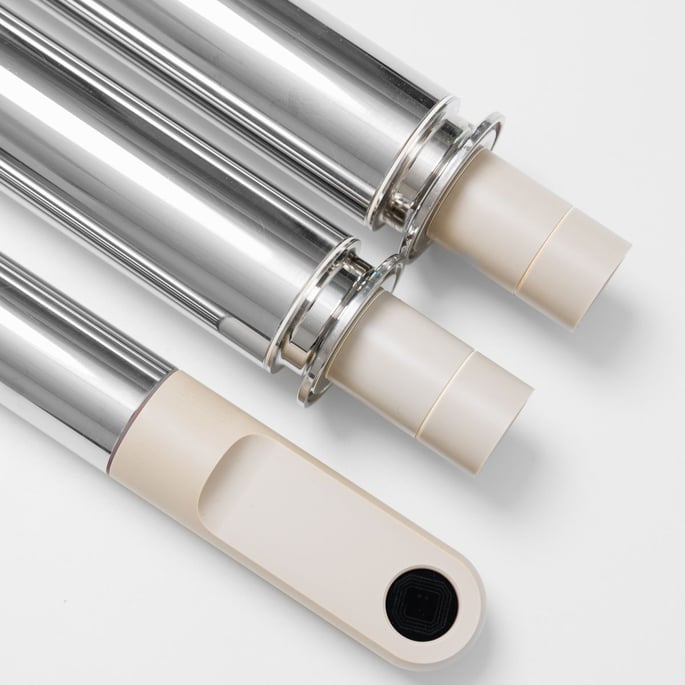
The system works by monitoring the RF response pattern throughout the pushout. As Product A clears the line and Product B enters, the electromagnetic signature shifts. This transition is visible in real-time, often revealing interface dynamics that traditional sensors cannot detect. Operators see not just "Product A" or "Product B," but the entire transition curve—how quickly the changeover occurs, whether mixing zones are larger or smaller than expected, and precisely when the new product reaches specification.
The impact of this precision is significant. Even small timing errors—just a few seconds—can cause 1-2% product loss or dilution. At production scale, these invisible losses compound into substantial annual costs. A dairy processing facility running 50 changeovers weekly with just 100 litres lost per changeover discards 260,000 litres annually. For high-value products, this represents significant financial impact.
With pushout optimisation, facilities can recover meaningful volumes of product that would otherwise be discarded through conservative safety margins. The technology provides the confidence to push closer to the actual transition point, knowing that the data will reveal the interface with certainty.
Beyond simple detection
What makes Collo's approach unique is that the system doesn't just detect a change—it provides real-time visibility into the liquid composition throughout the entire pushout process. Operators can see the transition happening in real-time and make informed decisions about when to switch collection tanks, optimising for both product recovery and quality assurance.
This visibility reveals changeover dynamics that static protocols miss:
Variable transition speeds: Some changeovers complete faster than expected, others slower. Real-time monitoring adapts to actual conditions rather than assumed averages.
Product-specific interface behaviour: High-viscosity products create longer mixing zones than thin liquids. Pushout optimisation accounts for these differences automatically.
Line configuration effects: Different pipe lengths, dead legs, and equipment configurations all affect changeover behaviour. Real-time data shows what's actually happening in your specific system.
Optimising different types of changeovers
Pushout optimisation delivers value across multiple changeover scenarios common in dairy and beverage production:
Product-to-product changeovers: Switching between different products (e.g., orange juice to apple juice, whole milk to semi-skimmed) where the interface must be precisely detected to avoid cross-contamination and maximise recovery.
Concentration changeovers: Transitions between different concentrations of the same base product (e.g., 10% juice to 50% juice, different cream fat percentages) where subtle composition changes must be accurately identified.
CIP-to-product transitions: The critical moment when cleaning solution clears and product flow begins—where over-conservative timing wastes product, but insufficient rinsing risks contamination.
Product-to-CIP transitions: Knowing exactly when to stop product collection and begin cleaning protocols, minimising product loss whilst ensuring complete system cleaning.
Each scenario benefits from the same fundamental capability: real-time, accurate detection of liquid composition changes that conventional sensors cannot reliably measure.
Measuring success in pushout optimisation
Facilities implementing pushout optimisation typically track several key metrics. Volume recovery per changeover measures how much additional product reaches collection tanks rather than drain, measured in litres per pushout event. Changeover frequency is another critical factor, as higher-frequency operations see proportionally greater annual impact from per-event improvements. Product value also plays a significant role—premium products such as speciality beverages, organic dairy, and high-margin ingredients make recovery optimisation particularly valuable. Finally, downstream effects must be considered, as reduced waste volume impacts wastewater treatment costs, environmental reporting, and sustainability metrics.
The cumulative annual impact often surprises facility managers. Small per-changeover improvements multiply across hundreds or thousands of annual events, creating substantial value that traditional monitoring approaches simply leave on the table.
The path forward
As dairy and beverage producers face increasing pressure to improve sustainability metrics, reduce waste, and operate more efficiently, pushout optimisation represents a clear opportunity.
Pushout optimisation transforms batch changeovers from unavoidable loss events into optimisation opportunities. Every transition becomes a chance to recover product, improve efficiency, and demonstrate that operational excellence and sustainability objectives align perfectly.
Ready to optimise your changeovers? Calculate how much you could be saving by optimising pushouts or contact our team to learn more about deployment options.

The true cost of product losses in dairy manufacturing: A data-driven analysis

Less waste, more visibility: Collo and IMD partner in Benelux