<img height="1" width="1" style="display:none" src="https://www.facebook.com/tr?id=1446880727106160&amp;ev=PageView&amp;noscript=1">
For dairy and beverage CIP systems

Clean-in-place (CIP) optimisation: overcleaning is overcostly

Real-time CIP optimisation that cuts waste, saves time, and elevates sustainability. The calculator below shows what your plant could save.
Clean water flowing into a stainless steel sink
Challenges we solve

Overcleaning is eating your margins

In food and beverage manufacturing, cleaning is essential. But standard CIP (Clean-In-Place) systems follow fixed programs, not actual process conditions. Without visibility into what’s happening inside tanks and pipelines, cleaning steps often run longer than necessary.

The result? Higher water and chemical use, longer cleaning times, and lost production hours. Over time, these inefficiencies increase utility costs, increase downtime, and add to emissions, making it harder to reach performance and sustainability targets.

Collo replaces static programs with live, data-driven control. By detecting when each step is truly complete, you can reduce rinse times, minimise resource use, and recover valuable production time, all without compromising safety or product quality.

The CIP calculator below estimates the water and time your plant could gain.
Dairy plant-1
Case Study: CIP OPTIMISATION

A beverage producer cut CIP time by 23% and saved half a million

A major European beverage producer was rinsing perfectly clean pipes with perfectly clean water. For 15 unnecessary minutes. Every cleaning cycle. 250 times a year. They suspected it. But suspicion doesn't change procedures. 

Data does.
Clarity in every cycle

Precision cleaning, powerful savings.

Collo Insights

Intelligence you can act on

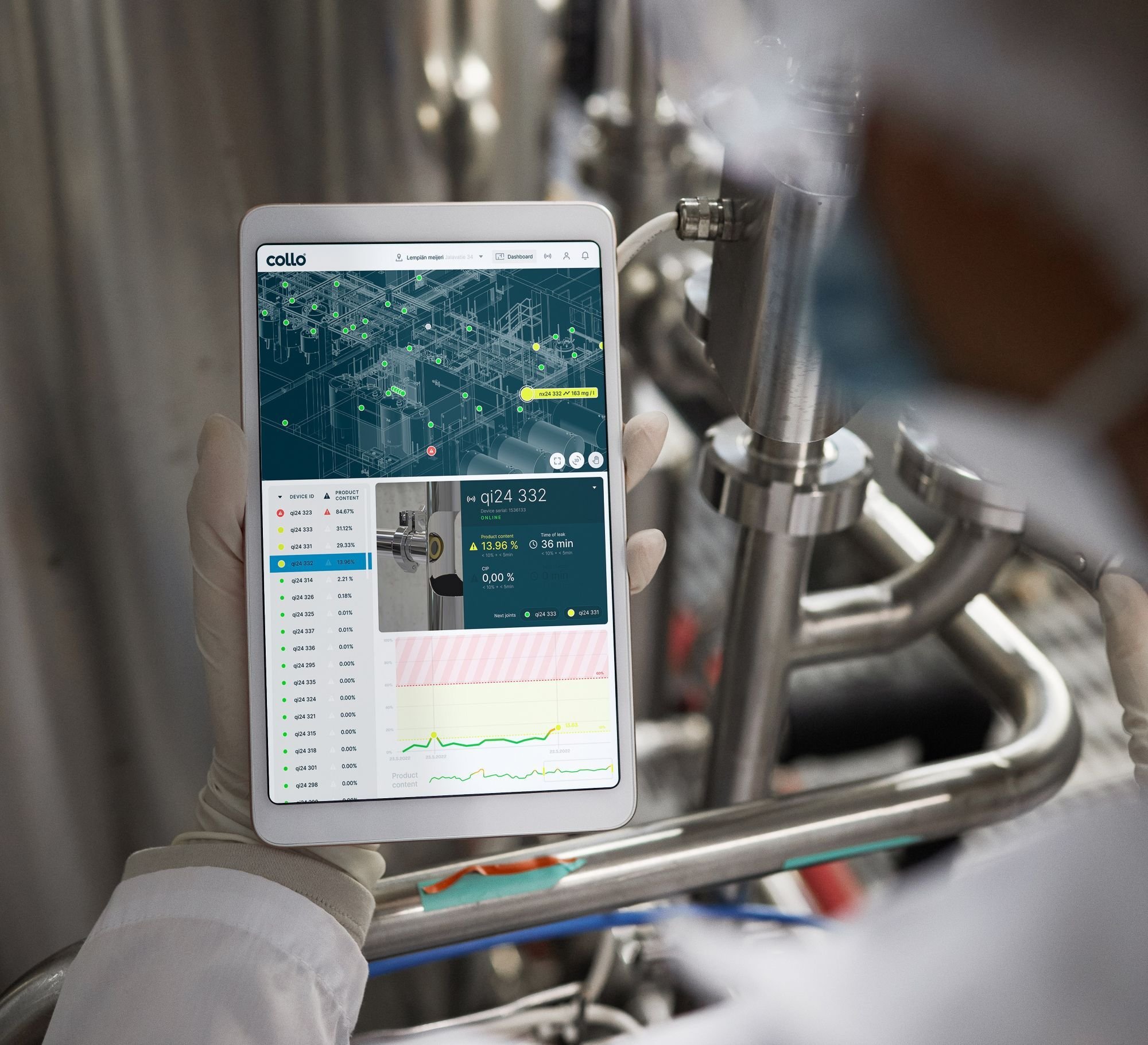
Collo Insights allows you to monitor all CIP cycles continuously. Analytics dashboards show where water, energy, and time are wasted. Expert recommendations for tuning your CIP programs.

Typical results:

  • 15–20% water savings opportunities identified
  • Lower organic load in wastewater
  • Production hours reclaimed from shorter cleaning
  • Annual savings identified
Collo Signals

Real-time process intelligence for automation

Collo Signals integrates directly with your automation system, bringing real-time intelligence into every CIP cycle. A "CIP stage complete" signal goes straight into your automation, so rinses end on actual cleanliness, not preset timers. CIP control becomes state-based.

Typical results:
• 15–20% water reduction per CIP cycle
• 15–20% shorter CIP duration
• Real-time cleanliness verification
• State-based control vs. time-based guessing

Quicker, smarter and more cost-effective CIP, run on what is actually in the pipe.
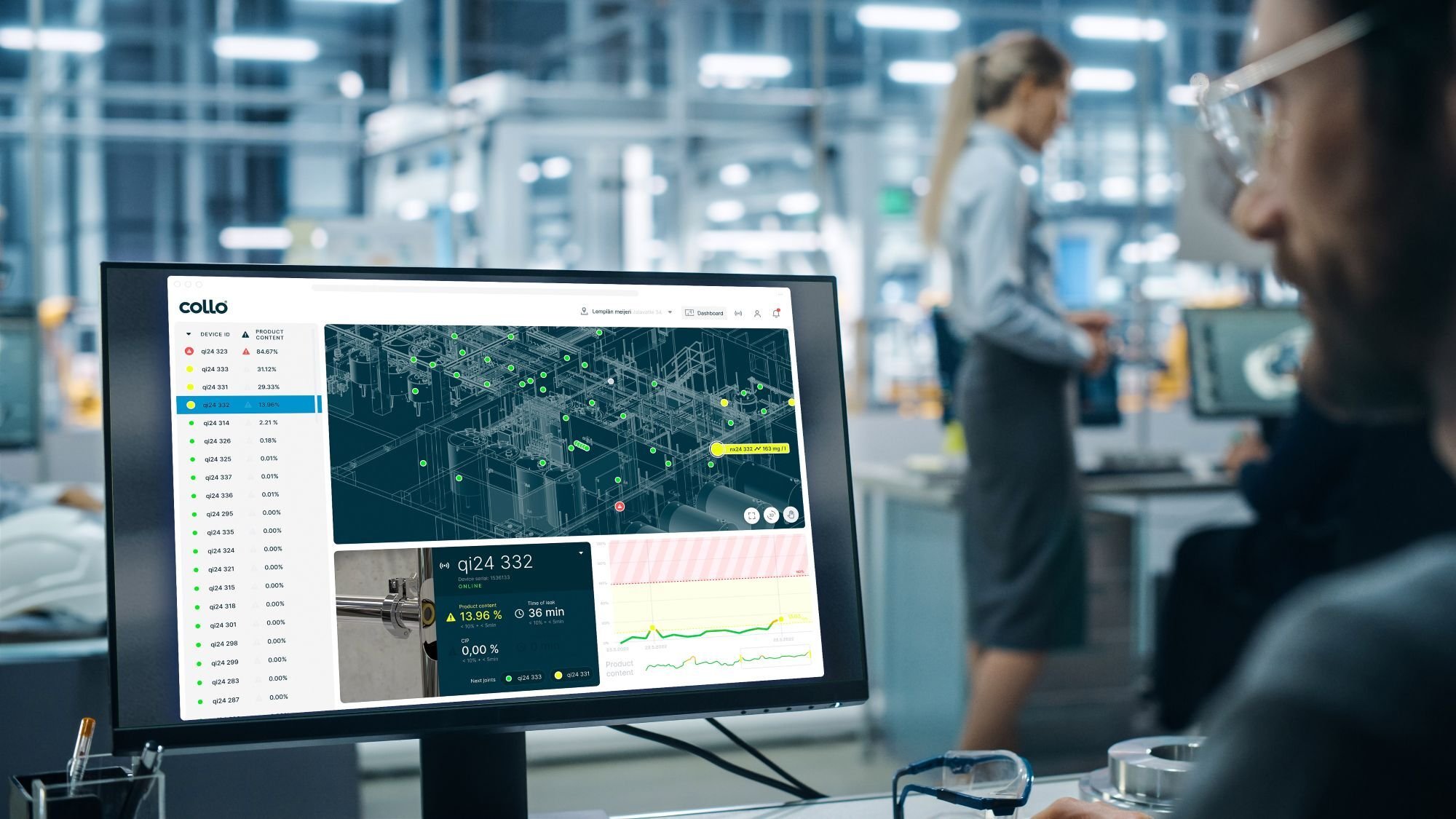
Signals-desktop-automation
Smarter CIP Starts Here

See inside your CIP cycles, in real time

This short video shows how Collo gives you instant visibility into your CIP cycles. Discover how Collo enables CIP cycle time reduction, reduces waste, and improves efficiency.

Features

Cut costs, not corners

Smart, efficient, and reliably compliant.

Real-time monitoring of each CIP phase

From pre-rinse to final flush, Collo tracks what actually happens inside your system.

Optimised cleaning durations

Each cleaning phase ends the moment it is complete: no guesswork, no waste.

Save water and chemicals

Lower resource consumption alongside better cleaning performance.

Add production hours back into your week

Shorter cleaning cycles give production hours back every week.

Improve ESG performance

Lower emissions, less water use, and reduced chemical discharge.

Fast payback

Under 12 months in our bottling reference case.
FAQ

Frequently asked questions

Answers to the questions we hear most about CIP optimisation. If yours is not here, contact us.

What is CIP optimisation?

Running each clean-in-place phase on the measured state of the liquid instead of a fixed time. Standard CIP programmes rinse and circulate for preset durations with a margin for error built in. CIP optimisation measures what is in the return line, so pre-rinse, caustic, intermediate rinse and final rinse each end when their job is done. The result is less water, fewer chemicals, less energy and more production hours, with cleaning verified rather than assumed.

How do we know when a CIP rinse is finished?

A Collo Analyzer in the CIP return line reads the complete fingerprint of the liquid every second and shows the moment the rinse stops carrying product or chemical. Conductivity only sees ions, so it confirms caustic but misses sugar, fat, protein and other non-ionic residues; turbidity needs particles and a clear line of sight. Reading the whole liquid is what makes the end-point reliable for opaque products too. Read the comparison guide.

What is the difference between state-based and recipe-based cleaning?

Recipe-based cleaning runs every phase for a set time and volume whatever the soil load. State-based cleaning ends each phase on a measured condition: product gone, chemical at strength, rinse clean. Collo Signals sends a "CIP phase complete" signal into your automation, the control logic stays in your PLC and the timer sequence is kept as a fallback. Plants usually start with Collo Insights to see where the slack is, then switch phases to state-based control one at a time.

How much can CIP optimisation save?

Customers save 15 to 20% of cleaning water and time. A European beverage producer cut CIP time by 23% and saved around half a million euros a year, and a large bottling plant saves about 4 million litres of water and 300 hours of cleaning time a year, with payback under 12 months. Your own figure depends on cycle count, line size and current margins, which is what the CIP savings calculator works out. Read the beverage producer case study.

How do we calculate CIP savings and payback?

Start from four numbers: CIP cycles per year, water and chemical volume per cycle, cycle duration and the value of a production hour. Apply a 15 to 20% reduction to water and time on the cycles under measurement, add the chemicals that scale with them and the production hours regained, and set the total against the cost of the deployment. In our bottling reference case payback came in under 12 months. The CIP savings calculator does the arithmetic with your inputs, and a Collo Insights deployment replaces the estimate with measured figures within weeks.

How much water and CO2 does cleaning account for across our plants?

In a liquid plant, cleaning is usually the largest controllable water use, and the hot water and pumping behind it carry most of the energy. Collo's impact assessment puts the recoverable cleaning water at a typical European dairy at about 5,500 m³ a year, with around 920 tonnes of CO2e, and at a typical beverage plant at about 2,100 m³. Collo Insights reports water, time, chemicals and energy per CIP cycle, line and plant, so a group can see the totals across sites on one measurement standard rather than estimates.

Which companies offer CIP optimisation technology, and how is Collo different?

CIP optimisation is offered by automation and hygiene suppliers as part of a wider system, and by sensor makers whose conductivity, turbidity or optical instruments switch phases on one property of the liquid. Collo is an independent measurement layer that works with any CIP system and automation vendor: one analyser reads the whole liquid, the same data runs changeovers and dilution detection, and expert recommendations come with Collo Insights. See how the technologies compare.

Does it work for both dairy and beverage CIP?

Yes. The measurement does not depend on colour or clarity, so it reads milk, cream and yoghurt base as well as soft drinks, juice and beer, and it sees fat and protein soils in dairy as well as sugar and acid soils in beverages. Collo has installations in 16 countries across dairy, beverage and liquid food.

How long does it take to implement, and will it disrupt production?

Two to three weeks from installation to first findings, and no production stop: the analyser goes in during a planned maintenance window. Start on the CIP circuits with the most cycles or the most valuable line time, then extend. The same hardware and reporting apply to every circuit and plant, so a group can roll out site by site.

How does Collo verify cleaning for food safety audits?

Every CIP cycle gets a timestamped measurement record showing when each phase actually reached its end-point. These records support the documentation that HACCP, FSSC 22000, BRCGS, IFS Food and ISO 22000 programmes require. The analyser's wetted parts comply with FDA 21 CFR 177 and EC 1935/2004, and the Varinline model is EHEDG EL Class I certified.

Contact us

Ready to clean smarter?

Stop cleaning on autopilot. With Collo, every CIP cycle becomes faster, cleaner, and more efficient, backed by real-time data and built for results. Let’s turn your cleaning process into a competitive edge.