The instruments agree. The product still isn't right.
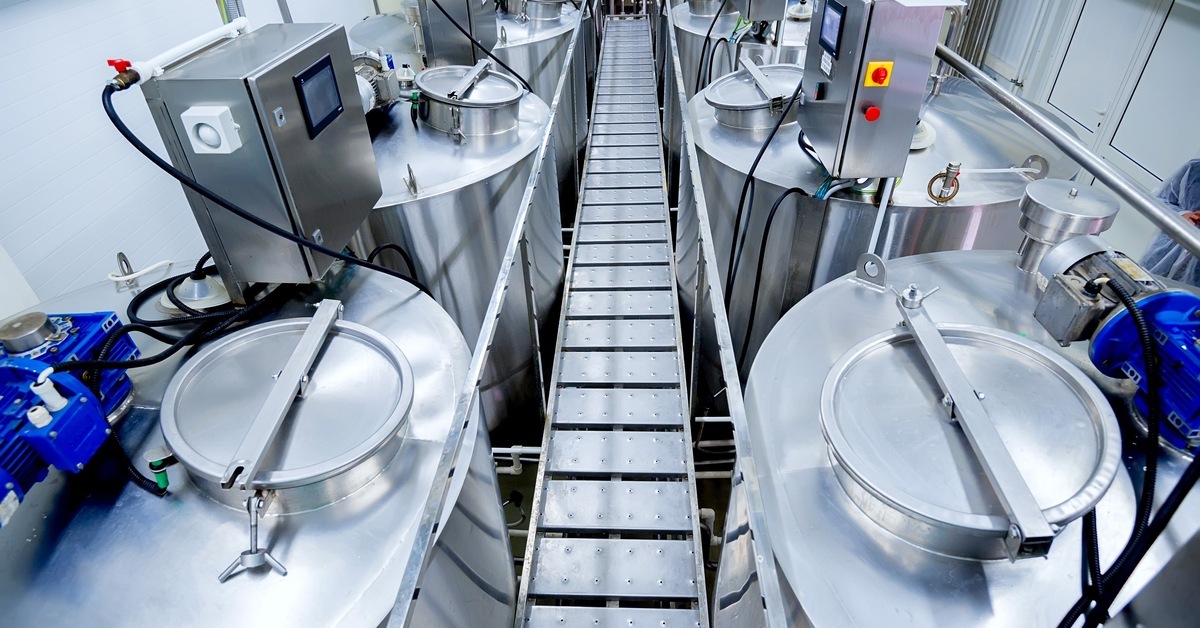
Walk the control room of a well-run dairy plant and every screen tells you the same thing: flow meters reading normally, conductivity in range, no alarms. By every instrument you own, the line is perfect.
And then the product comes back diluted
One plant operations manager we work with put it exactly: “Our automation was telling us everything was perfect, but we kept seeing diluted product.” If you've stood on that floor, you know the feeling: the numbers say one thing, the tank says another, and no one can point at where the two split.
This isn't a measurement failure. It's a blind spot built in by design: every instrument in that control room was built to confirm, not to see. Confirmation tells you the process ran. Seeing tells you what's in the pipe right now. The gap between the two is the interface, the handful of seconds where product becomes water and water becomes product. That's where the money moves.
Where the loss actually happens
The loss lives in the changeover: one liquid pushes the last one through the pipe, product chased by water, water chased by product. The moment they meet is the interface, and it's where good product slips to drain and clean water slips into the tank.
Per changeover, the error looks trivial: less than a percent. But this plant runs 450 to 1,000 changeover events at a single location, a changeover averages around 20,000 litres, and it processes 245 million litres of raw milk a year. A 0.8% error on one changeover, compounded across ten transition stages, reaches 7.7%. The loss isn't one big event anyone would notice. It's a thousand small ones no instrument was watching.
At its sharpest, the plant had clean water flowing into product tanks for up to 40 seconds at a time. Valves closed, pipes still full of water, automation reporting a clean changeover. Forty seconds, hundreds of times a week.
Three honest instruments, one blind spot
Every instrument in that control room is telling the truth — to its own question. A flow meter answers how much passed, not what it was: diluted and full-strength product read the same volume. Conductivity answers whether a transition happened, but not where the product-to-water boundary sat at the second it mattered. Mass balance answers whether the day added up, and it did: the loss hides inside the rounding. Three honest answers. Nobody asked what's in the pipe right now.
So the plant does the sensible thing with the tools it has. It runs conservative changeovers, longer than the product needs. It pulls more lab samples. It accepts a bit of dilution as the cost of being safe. Careful, compliant, and quietly expensive: the loss it can't see, it can't cost.
Turning on the lights
One European dairy plant pointed an instrument straight at the blind spot: nine Collo RF Analyzers inline, three on cream and six on raw-milk reception, with Collo Insights on the data. RF measurement reads the state of the liquid itself, in real time, and answers the question the legacy instruments never ask: this second is product, this second is water, this second is the mix in between.
For the first time the dilution had a shape. Between 1.3% and 2.28% of total product volume was quietly going to drain across the plant's changeovers. Not a suspicion, a measured figure, phase by phase, event by event. The process engineer's reaction says it best: “When we saw the Collo data compared to our flow meter readings, it was like turning on the lights.”
From visibility to €300,000
Priced against the plant's volume, the blind spot came to more than €300,000 a year. Recoverable, because once operators can see exactly where and when the interface slips, they tighten the changeover and take the value back.
The plant manager named the shift plainly: “The €300K number really opened everyone's eyes. We thought we had a small quality issue, but it turned out to be a major financial problem.” That's the move this piece is really about: a quality niggle on the floor becoming a number the plant manager can carry to the P&L.
Recovering the loss is step one. Stopping it is step two.
Build the Zero-Loss Factory
Collo Insights prices what the legacy instruments have been missing, changeover by changeover. Collo Signals feeds the same reading into your automation and stops the loss at source. One platform, and every line runs on the state of the liquid instead of a timer.
Insights shows the loss. Signals stops it. Most plants start with Insights to price what the instruments have been missing, then move to Signals to close the gap for good. That's the Zero-Loss Factory: not a pilot, an operating model.
Light up the plant. Then trust what you see.
Ready to turn on the lights? Talk to us about your highest-impact plant.