
By Collo on Mar 13, 2026

Most dairy and beverage plants still rely on sensors that measure one or two parameters in clear liquids. They drift, foul in contact with product, and cannot see through opaque liquids like milk, cream, or juice with pulp — forcing plants to compensate with safety margins that waste water, chemicals, time, and product.
The sensor landscape has changed. There are now six distinct measurement technologies available, each with fundamentally different strengths and limitations. This guide compares them all side by side.
The six measurement technologies
Conductivity
Conductivity sensors measure the ability of a liquid to conduct electrical current, indicating ion concentration changes. Low-cost and simple to install, but limited to one parameter with significant drift requiring weekly to monthly recalibration. Cannot differentiate between liquids with similar conductivity — a common problem during CIP phase transitions. Manufacturers include Endress+Hauser, ifm, and Mettler Toledo.
Turbidity
Turbidity sensors measure how light is scattered by particles suspended in a liquid. Useful for detecting phase changes in clear liquids, but they rely on light transmission and cannot measure through opaque liquids at all. Sensor windows foul quickly in dairy applications. Manufacturers include Anderson-Negele, Satron, and Endress+Hauser.
Refractometry (Refractive Index)
Refractometers measure the refractive index at the sensor prism surface, correlating with total dissolved solids. Not affected by opacity, viscosity, colour, particulate, bubbles, flow, or pressure — making it robust for Brix measurement in beverages.
However, the refractive index sums all dissolved matter into a single value and cannot distinguish between different solutes. It is less sensitive to ionic substances such as CIP chemical residues. Fat content above approximately 5% causes interference from optically active fat colloids, and certain products like quark yield unreliable results. Refractometry is expensive to deploy at scale — a key reason it has not been widely adopted in dairy. Manufacturers include Vaisala, Anton Paar, Maselli, and Atago.
UV-VIS Spectroscopy
UV-VIS spectroscopy analyses the light absorption spectrum of a liquid at ultraviolet and visible wavelengths. Good precision and specificity for clear liquids, but cannot measure through opaque liquids, struggles with fat and protein in dairy, and has limited real-time automation capability. Manufacturers include Anton Paar, AMETEK, and Endress+Hauser.
Laboratory Analysis (EMF / NIR-FTIR)
Laboratory instruments using electromagnetic field measurement or near-infrared spectroscopy provide the highest precision available — but they are not inline. Results arrive hours or days after the measurement was needed, making them unsuitable for real-time process control. Manufacturers include Speag, Keysight (EMF), FOSS, Bruker, and Thermo Fischer (spectroscopic).
RF Dielectric Measurement (Collo)
RF dielectric measurement sends radio frequency electromagnetic fields into the liquid and analyses the dielectric response across multiple frequencies. Collo's RF sensor creates an 8-parameter molecular fingerprint — measuring fat content, protein levels, contamination, chemical concentration, and phase transitions simultaneously.
Three things set it apart from every other inline technology. The sensor does not foul or drift — RF fields pass through product buildup, so it is calibrated once and runs indefinitely. It measures 8 parameters from a single sensor where others measure 1–2. And it works identically in opaque liquids like milk, cream, and chocolate as in water — no product-specific limitations.
RF dielectric measurement is the core technology behind Collo's liquid process intelligence platform.
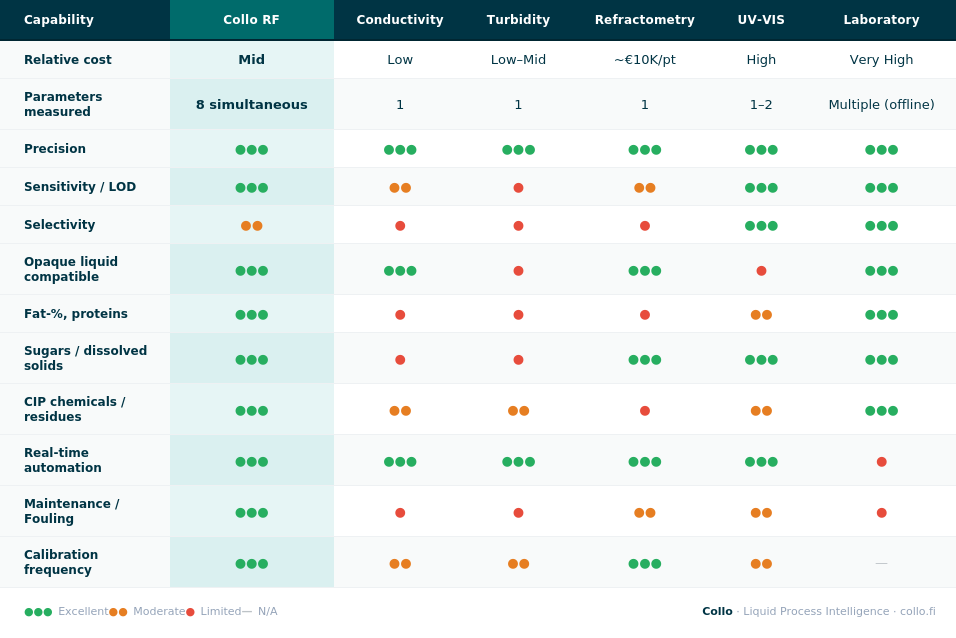
Unlike conductivity sensors, which measure one parameter, or refractometers, which sum all dissolved matter into a single value, RF dielectric sensors measure eight parameters simultaneously — providing a molecular fingerprint rather than a single data point.
What makes RF dielectric measurement different
The comparison matrix reveals a pattern: most inline measurement technologies excel at one or two things but fall short in others. Conductivity is cheap but limited. Refractometry is robust for dissolved solids but not selective and expensive at scale. Spectroscopy is precise but cannot handle opaque liquids.
RF dielectric measurement works on a fundamentally different principle. Rather than relying on light or simple electrical properties, it analyses the dielectric response of a liquid across multiple radio frequencies. This has three practical consequences.
No fouling, no drift.
RF fields pass through product buildup on sensor surfaces. There are no optical windows to coat, no electrodes to corrode. The sensor is calibrated once during installation and maintains accuracy indefinitely. This eliminates the single biggest source of ongoing cost with conventional sensors.
Eight parameters from one sensor.
Where other inline technologies give you one data point, Collo's approach gives you eight — fat content, protein levels, contamination, chemical concentration, and phase transitions, all measured simultaneously in real time.
Every liquid, every time.
The measurement works the same in whole milk, cream, chocolate, and concentrated cleaning chemicals as it does in water. No sensor swaps, no recalibration, no product-specific limitations.
CIP: Where sensor choice has Big impact
CIP (Clean-In-Place) accounts for 15–25% of total production time in dairy and beverage plants. Most of that time is driven by sensor uncertainty — conductivity cannot detect all phase transitions, and refractometers are less sensitive to ionic CIP chemicals. The standard response is to run every phase 15–30% longer than necessary.
Collo detects exact phase transitions throughout the entire CIP cycle, enabling automated, optimised cycles with no safety margin padding. Our customers typically see 15–25% cycle time reduction and 20–30% water savings in CIP.
Changeover: The other major cost driver
Changeovers — the transitions between products, or between product and water — are responsible for some of the largest hidden losses in dairy and beverage manufacturing. A timing error of just a few seconds means product goes down the drain or gets diluted. Traditional sensors cannot detect these interfaces reliably: flow meters lack precision, conductivity and turbidity sensors cannot distinguish between similar liquids, and the losses are invisible inside steel pipes.
Collo detects the exact product-water interface in real time, enabling valve automation based on actual product detection rather than estimated timing. Our customers typically recover 15–25% of product from pushouts — turning invisible losses into measurable savings.
The Bottom Line
No single sensor technology is right for every application. The right choice depends on what you are measuring, what liquids are involved, and what you are optimising for. What has changed is that there are now options beyond the conductivity and optical sensors that have dominated for decades — and the differences in capability, maintenance, and total cost of ownership are significant.
If you want to go deeper, we have published a comprehensive Technology Comparison Guide covering all six technologies in detail, including a 5-year TCO analysis and a decision framework.
Want to explore what RF technology could do at your plant? We'd love to help you optimise your processes.
ColloidTek in China – integrating global innovation resources in Nanjing Tech Week

Collo in Stream Startup Festival 2019
