
PRESS RELEASE · 29 SEPTEMBER 2026 · TAMPERE, FINLAND
Europe's factories pour away up to 40% more food than the EU counts, because the rules assume it can't be measured
Food poured down the drain in dairies and beverage plants adds an estimated 13% to 42% on top of the food waste Europe's factories officially report. A rule written in 2019 leaves it out because it "couldn't be measured". It can now. And not only measured, but avoided.
Tampere, Finland, 29 September 2026. Every dairy, brewery and juice plant in Europe knows the arithmetic. A hundred million litres a year come in through the tanker bay. Ninety-seven million, sometimes fewer, leave in cartons, bottles and cans. The rest went down the drain, mixed with the water used to rinse the pipes between one product and the next.
Across the EU, that leftover adds up. Figures published today by Eurostat put the bloc's food waste at around 58 million tonnes in 2024, about 129 kilos per person. But the official number does not include anything that leaves a factory with the wastewater. An analysis using the European Commission's own loss rates and Eurostat's production data suggests that missing waste is between 1.4 and 4.6 million tonnes a year. That is at least a tenth more than factories report, and possibly more than 40 per cent more.
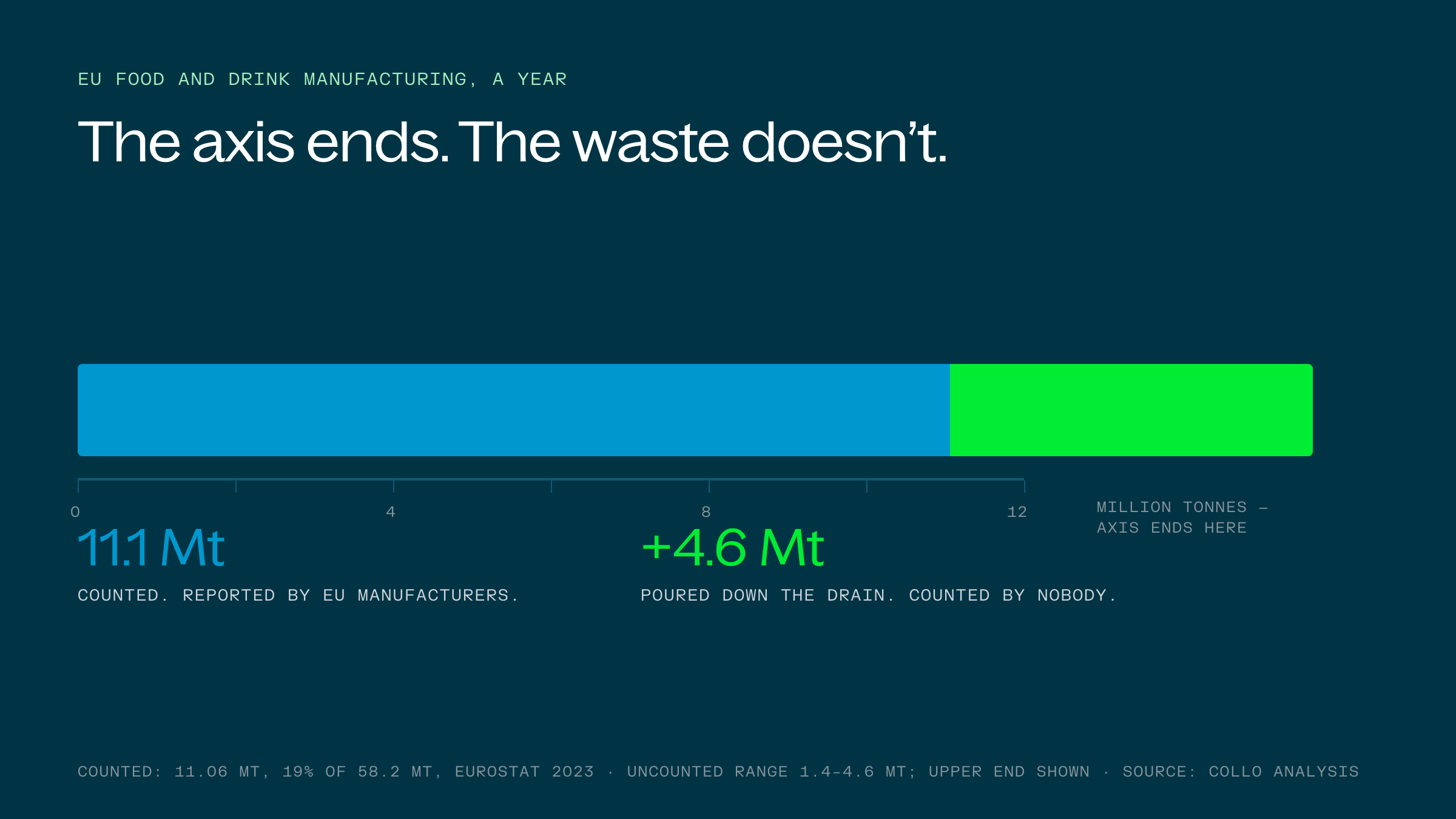
The axis ends, the waste doesn't: the 11.1 million tonnes EU manufacturing reports, and the up to 4.6 million tonnes that leave with the water. Source: Collo analysis. Free to use with credit.
Put another way, it is between three and ten litres of milk, beer and juice for every person in the EU, every year, poured away before any of it reaches a shop. The milk alone would be worth between €320 million and €1.3 billion a year, before anyone turned it into cheese or yoghurt. Even on the most cautious reading (drinking milk and cheese only, using nothing but the Commission's own loss rates), it is more than half a billion litres of milk a year.
A rule written for 2019
The reason none of it counts is an EU decision from 2019. When the EU agreed how to measure food waste, it ruled that food "drained as or with wastewater" would be left out, because at the time nobody could measure it reliably. That rule now sits underneath a binding target: since October 2025, Europe's food manufacturers must cut their food waste by ten per cent by 2030. The one loss most liquid-food plants could actually cut is the one the target cannot see.
"Every plant knows how much," says Jani Puroranta, chief executive of Collo, the Finnish sensor and analytics company that carried out the analysis. "A hundred million litres in, ninety-seven million out. The difference went down the drain, and it shows up in the mass balance. At least half of it, if not more, could be avoided and recovered with today's technology. What nobody could do in 2019 was measure it as it happens, litre by litre, so you could stop it. The EU's measurement rules were written in 2019, when that technology did not exist. It exists now."
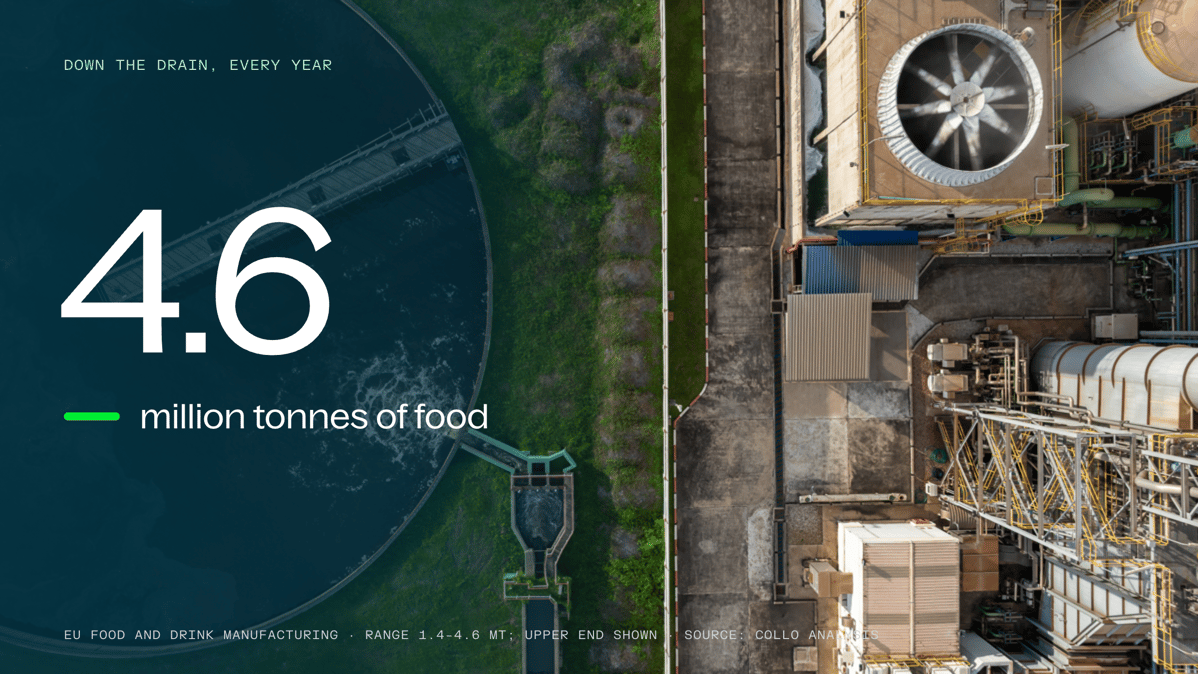
The 2019 measurement rules and the 2030 target: it can be measured now, it still isn't counted. Source: Collo analysis. Free to use with credit.
Nothing dramatic ever happens
The losses are rarely spectacular. A valve switches 30 seconds late when a line changes from one cream batch to another. A cleaning rinse runs longer than it needs to. A batch is cut off early to protect quality, with an over-cautious safety margin. Each sends a few hundred litres to the drain. Over a year, at one European dairy handling 245 million litres of milk, it added up to as much as five million litres, with no alarm ever sounding and the monthly figures looking like business as usual.
"Spoilage and quality rejects are already kept to a minimum in every plant I know," Puroranta says. "The loss a factory can still reduce significantly is the one that leaves with the water. That is precisely the one the new EU target ignores. So what, exactly, are companies supposed to reduce by ten per cent?"
Europe is not alone. The United States counts food sent down the sewer as waste in principle, but its Environmental Protection Agency has no figures for it from food manufacturers. Britain counts the sewer for households, not for factories.
There is already a box for it
The EU's reporting form has a column for food drained with wastewater. Filling it in is voluntary, and no country's figures have been published. Governments writing the 2030 target into national law before June 2027 can ask their processors for the number now, and the Commission's review of the targets, due by the end of 2027, can take it into account. Nobody is asking for new targets, only that the missing waste be measured and counted.
"The law was written for the technology of 2019," Puroranta says. "Legislation moves in ten-year cycles; measurement has moved faster. The next review is the moment to catch up."
Notes to editors
-
Three checkable facts: (1) Directive (EU) 2025/1892, Art. 9a; Delegated Decision (EU) 2019/1597, Art. 1(5)(a) and recital 10, both on EUR-Lex. (2) Loss rates: JRC Best Available Techniques Reference Document, Food, Drink and Milk Industries (2019); USDA cheese-plant data; Collo plant measurements. (3) The estimate: dairy 150.8 Mt × 0.5–2% = 0.75–3.0 Mt; beer 34.4 bn L × 1–3%; soft drinks ~52.6 bn L × 0.5–1% (assumed rate); juice ~7 bn L × 0.5–1%; total ≈ 1.4–4.6 Mt against 11.06 Mt reported (19% of 58.2 Mt, Eurostat 2023); Eurostat's 2024 figures published today (58 million tonnes in total, manufacturing 25 kg per inhabitant, about 11 million tonnes) leave the comparison unchanged. Per person: 449 million EU residents, 1 litre ≈ 1 kg. Floor: 22.5 Mt drinking milk × 1.9% + 76.1 Mt milk for cheese × 0.2% ≈ 0.58 Mt. Value at the EU farm-gate milk price, 42.6 c/kg (May 2026). Full method note available on request.
-
Charts (attached, free to use with credit "Source: Collo analysis"): 1) Counted vs uncounted: the 11 Mt the EU reports and the 1.4–4.6 Mt it doesn't; 2) What every plant already knows: 100 in, 97 out; 3) Where discarded food goes and whether the EU counts it;
-
Plant evidence: a European dairy processing 245 million litres a year measured product dilution of 1.3–2.28% of volume with no alarm raised. Another European dairy cut pushout losses by 92% on a single line with Collo and recovers 260,000 litres of product a year (published).
-
Press contact and interviews: Jani Puroranta, CEO, Collo · jani.puroranta@collo.fi · +358 50 517 9992 · available 29–30 September in English and Finnish. A method note for the estimates is available on request.
-
About Collo. Collo is transforming how industries manage their liquid processes. Our breakthrough liquid analyzers based on radio frequency go beyond conventional inline sensors by capturing the complete fingerprint of liquids in real time. Powered by AI and machine learning algorithms, this data reveals hidden product losses, wasted water, and quality deviations that typically remain invisible. For dairies and beverage producers, Collo means higher yields, lower costs, and more sustainable operations, all achieved without disrupting existing processes. For more information, visit www.collo.fi.
Downloads
Images and charts on this page are free to use with the credit "Source: Collo analysis".